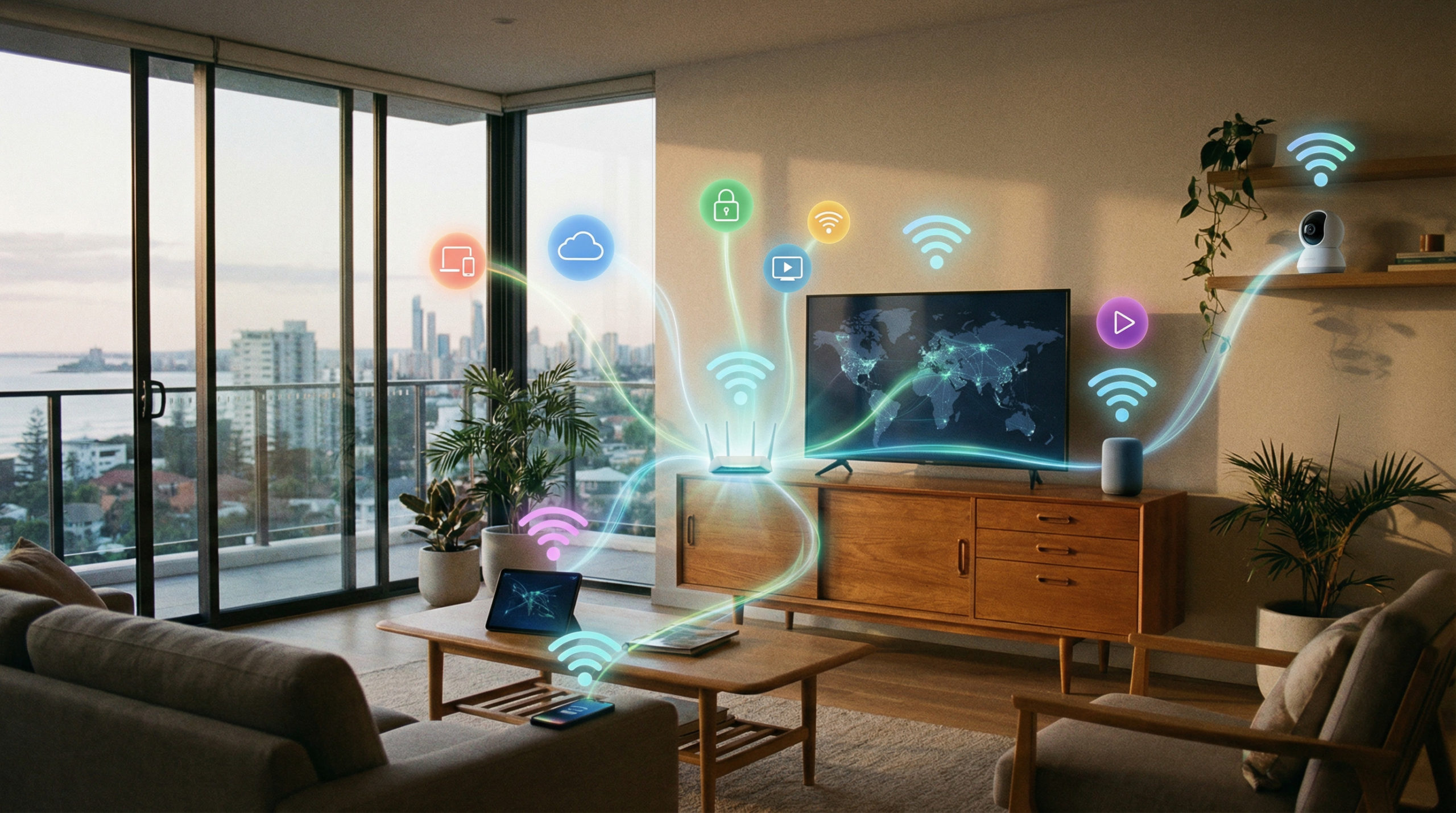
The Tech in Your Home is Evolving Faster Than Your Internet
Remember when “going online” meant sitting at a desktop computer and hearing that iconic dial-up screech? Those days feel like ancient history. Now your fridge has more computing power than that old desktop, and it’s probably connected to the internet too.
Your devices are getting smarter. Your TV isn’t just a screen anymore, it’s a streaming powerhouse with AI upscaling and voice control. Your phone is running machine learning algorithms in real-time. Your home assistant is processing natural language and controlling your entire house. Your watch is tracking your health metrics and syncing to the cloud constantly.
But here’s the question nobody’s asking: Is your internet actually keeping up with all this intelligence?
If you set up your NBN plan five years ago based on “we stream Netflix sometimes and browse the web,” you’re probably already behind. Let’s talk about what your smart devices actually need, and whether your connection is delivering it.
Key Takeaways
Your smart devices need more internet than you think. Here’s what you need to know:
- AI assistants aren’t in your speaker – they’re in the cloud, requiring constant connectivity and low latency for every command
- 4K streaming is just the start – modern smart TVs use AI upscaling, cloud processing, and background downloads that add hidden bandwidth demands
- Gaming demands have exploded – a single game download can be 200GB, and cloud gaming needs 50mbps+ just to function
- Upload speed matters more than ever – video calls, security cameras, and cloud backups all depend on upload bandwidth that most people ignore
- Smart home devices multiply quietly – each individual device uses minimal bandwidth, but 20+ devices adds up to constant baseline usage
- One 4K stream uses 25mbps – multiply that by your household and you quickly see why NBN 25 or 50 isn’t enough anymore
- Your 2024 devices need more than your 2019 devices – even for the same tasks, newer tech has higher bandwidth requirements
- Peak hour usage is the real test – your internet might work fine at 2pm but struggle at 7pm when everyone’s home
- Future tech is coming fast – VR, 8K streaming, and spatial computing will demand even more bandwidth within years, not decades
- Flexibility beats contracts – your device ecosystem will change, so your internet plan needs to change with it
Bottom line: If you set up your NBN plan more than three years ago, it’s probably time to reassess. Your devices have gotten smarter. Your internet needs to keep up.
The AI Assistant Reality Check
You’ve got a smart speaker in the kitchen. Maybe one in the bedroom too. Alexa, Google Assistant, or Siri responding to your every command. Feels like living in the future, right?
Except when you ask a question and get “Sorry, I’m having trouble connecting right now.” Or when there’s that awkward three-second delay between your question and the response. Or when your smart home commands just don’t execute.
Here’s what most people don’t realise: your AI assistant isn’t actually in that speaker. The intelligence is in the cloud. Every time you ask a question, your voice gets sent to massive data centers, processed by AI models, and sent back to you. All of that happens in milliseconds when your internet is up to scratch.
What AI Assistants Actually Need:
- Consistent low latency (under 50ms is ideal)
- Reliable upload speeds (2-3mbps minimum per device)
- No dropouts or connection instability
- Enough bandwidth to not compete with other devices
That “smart” speaker on NBN 25 with three other people streaming? It’s struggling. The AI is fine. Your internet is the bottleneck.
The Multiplier Effect:
One smart speaker is manageable. But you’ve probably got more than one. Smart display in the kitchen. Speaker in the bedroom. One in the lounge. Each one constantly maintaining a connection, listening for wake words, processing commands.
Add in your phone’s AI assistant, your smart TV’s voice control, and maybe a smart doorbell with AI person detection. Suddenly you’ve got six or seven AI-powered devices all needing consistent cloud connectivity. That adds up faster than you’d think.

Smart TVs Aren’t Just Screens Anymore
Your new 4K TV isn’t just displaying content. It’s running a full operating system. Processing HDR. Upscaling content with AI. Running apps. Voice control. Screen mirroring. The works.
What Your Smart TV is Actually Doing:
- Streaming 4K content (25mbps per stream)
- AI upscaling requiring processing power and occasional cloud connectivity
- Downloading app updates automatically
- Syncing viewing data and preferences
- Processing voice commands
- Screen mirroring from phones and laptops (5-10mbps)
- Downloading firmware updates (can be multiple gigabytes)
The Sneaky Bandwidth Eater:
4K streaming is the obvious one. Everyone knows that needs bandwidth. But what about AI upscaling? Your TV is taking 1080p content and using AI to enhance it to 4K in real-time.
The latest models from Samsung, LG, and Sony are using cloud-assisted AI processing for this. Your TV sends frames to the cloud, gets back enhanced versions, displays them. All happening so fast you don’t notice. But it’s using bandwidth you didn’t budget for.
Then there’s the automatic downloads. Your smart TV updates its apps in the background. Downloads new firmware. Syncs your viewing habits for recommendations. All while you’re trying to watch something.
The Family Reality:
One person watching 4K Netflix on the smart TV: 25mbps. Add someone else streaming on their iPad in another room: 50mbps. Add the kids watching YouTube in HD on the lounge room TV: 60mbps. Add background AI processing, app updates, and smart home devices: 70mbps+.
If you’re on NBN 50, you’re maxed out. Any other internet activity and someone’s stream is buffering. This is the reality of modern smart homes.
Gaming Consoles Have Become Data Monsters
Your PlayStation 5 or Xbox Series X isn’t just a gaming machine anymore. It’s your streaming hub. Your social platform. Your media center. And it’s absolutely demolishing your bandwidth budget.
The Modern Console Demands:
- Game downloads: 50-150GB per game (200GB for some titles)
- Constant game updates: 10-50GB patches regularly
- Cloud gaming: 35mbps+ for quality streaming
- Online multiplayer: 3-5mbps but needs low latency
- 4K streaming apps: 25mbps
- Party chat and voice communication: 1-2mbps
- Background downloads and updates while you play
The Download Time Reality Check:
NBA 2K24: 150GB Call of Duty: Modern Warfare 3: 200GB+ Baldur’s Gate 3: 150GB Final Fantasy XVI: 90GB
On NBN 50, downloading a 150GB game takes roughly 7-8 hours. On NBN 100: 3-4 hours. On NBN 1000: 20 minutes.
Time is money. Excitement is finite. Waiting eight hours to play a game you just bought is a vibe killer.
The Cloud Gaming Consideration:
Xbox Game Pass streaming. PlayStation Plus Premium cloud games. GeForce Now. These services let you play high-end games without downloading them.
The catch? You’re streaming the entire game in real-time. Video and audio coming down to you, your controller inputs going up to the server. It needs 35mbps minimum for 1080p, 50mbps+ for 4K, and absolutely demands low latency.
If your connection drops for even a second, your game stutters. If your ping spikes, you’re getting input lag. Cloud gaming is incredible technology, but it’s extremely demanding on your internet.
Work From Home Tech Has Leveled Up
Remember early 2020 when everyone discovered their home internet couldn’t handle Zoom calls? We’ve come a long way. The tech has improved. But the demands have increased even more.
Modern WFH Technology Needs:
- HD video calls: 3-5mbps
- 4K video calls: 15-20mbps
- Screen sharing with high-res content: 5-10mbps
- Cloud file syncing (Dropbox, Google Drive, OneDrive): Constant background usage
- VPN connections: Adds overhead to everything
- Virtual desktop infrastructure: 10-25mbps
- Large file uploads: Depends on upload speed (often the forgotten metric)
The Hybrid Work Reality:
You’re on a Teams call in 1080p: 4mbps. You’re screen sharing a presentation: +5mbps. Your phone is backing up to iCloud: +3mbps. Your partner is on a Zoom call in another room: +4mbps. Your laptop is syncing files to Dropbox: +2mbps. Total: 18mbps used, not including any other household internet activity.
On NBN 25, you’ve got 7mbps left for everything else. Your kids’ online learning. Streaming. Smart home devices. It’s not enough.
Upload Speed: The Forgotten Metric:
Everyone focuses on download speed. But work from home lives on upload speed. Your video feed going to your colleagues. Your large files uploading to the cloud. Your screenshare presentation.
Most NBN plans have asymmetric speeds. NBN 50 gives you 50mbps down, but only 20mbps up. NBN 100 gives you 100mbps down, 20-40mbps up. If you’re uploading large video files or running video calls all day, that upload cap matters more than your download speed.
Consider NBN 500 or higher if you’re regularly uploading content. The upload speeds are significantly better and can make the difference between smooth video calls and pixelated disasters.

Smart Home Devices: Death By a Thousand Pings
Individual smart home devices don’t use much bandwidth. Your smart light bulb isn’t streaming 4K video. But collectively, they’re constantly communicating, and it adds up.
The Math Nobody Does:
Each device maintains a constant connection. Minimal data, but constant. Add it up:
- 10 smart lights: ~0.5mbps combined
- 3 smart speakers: ~2mbps
- 2 smart displays: ~3mbps
- 1 video doorbell: ~2mbps (more when recording)
- 4 security cameras: ~8-12mbps (constant streaming to cloud)
- Various sensors and plugs: ~1mbps
- Total baseline: ~17-20mbps just maintaining your smart home
That’s before anyone in your house actually uses the internet for anything.
Security Cameras: The Bandwidth Killer:
Indoor cameras aren’t too bad. 720p footage at 1-2mbps per camera. Outdoor cameras recording 1080p or 4K? Different story entirely.
A single 4K security camera recording 24/7 and uploading to cloud storage uses approximately 4-6mbps constantly. If you’ve got four outdoor cameras, that’s 16-24mbps of your bandwidth just for security footage.
Ring doorbells. Nest cameras. Arlo systems. They’re brilliant for security. They’re also eating your bandwidth for breakfast, lunch, and dinner
Emerging Tech on the Horizon
What you’ve got today is just the beginning. The tech coming in the next few years makes current demands look quaint.
Apple Vision Pro and VR Headsets:
Mixed reality is here. Apple Vision Pro, Meta Quest 3, PlayStation VR2. These devices need massive bandwidth for high-resolution wireless streaming.
Current VR gaming over wireless: 100mbps+ Future AR/MR applications: Potentially 200-300mbps Multiple people in the same house using VR: Do the math
AI Everywhere:
Your phone’s AI features. Your laptop’s AI assistant. AI photo editing. AI video generation. Most of this processing happens in the cloud because local hardware can’t handle it.
Every AI feature you use is sending data up, processing in massive data centers, sending results back. As AI features become standard in every device, that constant cloud communication becomes your new baseline usage.
8K Streaming:
It’s coming. YouTube already supports it. Streaming services are testing it. 8K streaming requires 50-100mbps per stream. Will you need it? Maybe not. But the option existing means bandwidth demands will keep climbing.
Spatial Computing:
Zoom calls where everyone appears as holograms. Virtual workspaces. 3D content creation. These aren’t sci-fi anymore. Apple, Meta, and Microsoft are all pushing spatial computing. The bandwidth requirements are bonkers.
The Pattern:
Every generation of technology demands more bandwidth than the last. 4K seemed excessive when we had 1080p. Now it’s standard. 8K will follow. VR was niche, now it’s mainstream. The internet connection you need isn’t just for today. It needs headroom for tomorrow.
The Upload Speed Problem Nobody Talks About
Everyone obsesses over download speed. How fast can you stream? How quickly can you download games? Important questions. But there’s another metric that matters just as much for modern smart homes: upload speed.
The Asymmetric Problem:
Most NBN plans are asymmetric. Your download is much faster than your upload:
- NBN 25: 25mbps down, 5mbps up
- NBN 50: 50mbps down, 20mbps up
- NBN 100: 100mbps down, 20-400mbps up
- NBN 500: 500mbps down, 50mbps up (yes, it’s weird)
- NBN 1000: 1000mbps down, 100mbps up
- NBN 2000: 1000mbps down, 100mbps up (on HFC) or 200mbps up (on FTTP)
That upload speed matters more than people realise. You can have NBN 100 and still struggle with video calls if your upload is saturated by security cameras uploading footage.
The Work From Home Bottleneck:
You’re on a video call. You look pixelated and frozen to everyone else, but you can see them fine. That’s an upload problem, not a download problem.
You’re trying to upload a 5GB video file to Google Drive. On 20mbps upload, that’s about 33 minutes. On 40mbps upload, it’s about 16 minutes. Upload speed matters.

The “But I’m Only Using [X]% of My Plan” Trap
Here’s a trap people fall into: they check their speed test, see they’re getting their full plan speed, and assume everything’s fine.
Speed tests measure maximum potential. They don’t measure real-world usage patterns.
The Real-World Scenario:
You’ve got NBN 100. Speed test shows 97mbps. Great! Except:
- 6pm rolls around
- Someone starts streaming 4K Netflix: -25mbps
- Kids start YouTube: -10mbps
- Security cameras upload motion clips: -8mbps
- Smart home devices doing their thing: -5mbps
- Background app updates on various devices: -10mbps
- Someone decides to video call grandma: -5mbps
- Total used: 63mbps
- Remaining: 37mbps
That 37mbps gets split between everything else. Someone tries to download a game update? Everything slows down. Someone starts a second 4K stream? Buffering begins.
You’re “only” using 63% of your plan, but everyone’s experiencing slowdowns. That’s the reality of modern households.
Peak Hour Congestion:
Speed tests at 2pm might show 97mbps. But at 7pm, when everyone on your street is streaming, you might only get 45mbps due to network congestion.
That’s why “typical evening speeds” matter more than theoretical maximums. Check what your plan actually delivers during peak times, not what it promises in optimal conditions.
The Generational Device Gap
Here’s something interesting: devices from different eras have wildly different internet needs.
Your 2019 Smart TV:
- Streams 4K: 25mbps
- Basic apps
- Simple interface
- Total needs: ~30mbps peak
Your 2024 Smart TV:
- Streams 4K with AI upscaling: 30mbps+
- Cloud gaming capable
- AI voice assistant with constant connection
- Multiple apps running simultaneously
- 8K capable (if you’ve got the content)
- Total needs: ~50mbps peak
Same use case (watching TV), but the 2024 model needs significantly more bandwidth because it’s doing more processing, more AI features, more smart capabilities.
The Household Reality:
You probably don’t replace all your devices at once. You’ve got:
- A 2024 flagship phone
- A 2022 laptop
- A 2020 smart TV
- A 2023 gaming console
- Various smart home devices from different years
Each generation is slightly more demanding. As you upgrade devices, your internet needs increase incrementally. The NBN plan that worked in 2020 might not cut it in 2024, even if your usage patterns haven’t changed, because your devices are doing more.
What Plan Do You Actually Need?
Let’s get practical. Based on modern device demands, here’s the reality:
NBN 25:
- Good for: Single person, light usage, no 4K streaming, minimal smart home
- Struggles with: Multiple devices, any 4K content, video calls while others use internet
- Verdict: Probably too slow for most modern households
NBN 50:
- Good for: 1-2 people, some streaming, basic smart home, light gaming
- Struggles with: Multiple 4K streams, large downloads, households with 3+ people
- Verdict: Minimum for small modern households, but not much headroom
NBN 100:
- Good for: 2-4 people, regular 4K streaming, decent smart home, work from home, gaming
- Struggles with: Multiple simultaneous 4K streams, heavy smart home usage, households with 5+ people
- Verdict: Sweet spot for most Australian families
NBN 250:
- Good for: 4+ people, extensive smart home, multiple gamers, heavy streaming, work from home with large uploads
- Struggles with: Honestly, not much. This handles most household needs comfortably
- Verdict: Future-proof choice for tech-heavy households
NBN 1000:
- Good for: Large households, content creators, multiple remote workers, extensive smart home, future tech
- Struggles with: Only your budget
- Verdict: Overkill for most, perfect for some, increasingly relevant as devices get smarter
The No-Contract Advantage for Evolving Needs
Here’s the thing about smart home evolution: it’s unpredictable. You don’t plan to buy three new smart cameras next month, but there’s a sale and suddenly you’ve upgraded your security system. You don’t plan for your kid to get into streaming, but now they need upload bandwidth.
Your needs change. Your internet plan should be able to change with them.
The MATE Flexibility:
Start with NBN 100 because that’s what makes sense today. Three months later, you’ve added security cameras and realized you need more bandwidth? Upgrade to NBN 500 (if you are on a fibre connection). No penalties. No contract breaking fees. No hassle.
Holiday period with everyone home streaming constantly? Bump up to 1000 for a couple months. Kids back at school and usage drops? Scale back to 500. That’s the flexibility modern households need.
Traditional 24-month contracts lock you into yesterday’s needs. Your devices and usage patterns will change significantly over 24 months. Why should your internet plan be stuck in the past?

The Real Cost of Underspeccing Your Internet
Slow internet isn’t just annoying. It has real costs:
Time Costs:
- Waiting hours for downloads instead of minutes
- Buffering during movies (time wasted, momentum lost)
- Restarting video calls that drop
- Troubleshooting connection issues
Opportunity Costs:
- Can’t take advantage of cloud gaming subscriptions you’re paying for
- Can’t use smart home features you bought devices for
- Can’t work effectively from home
- Can’t enjoy the 4K TV you paid premium for
Frustration Costs:
- Family arguments over bandwidth
- Gaming sessions ruined by lag
- Work presentations failing due to connection
- General decrease in quality of life
The Math:
NBN 100 vs NBN 50 is about $10-20/month difference. That’s $120-240/year.
Compare that to:
- Time wasted waiting for downloads: Hours per month
- Quality of smart device experience: Significant
- Ability to use devices you’ve already paid for: Priceless
You’ve invested thousands in smart TVs, gaming consoles, security cameras, smart home devices. Don’t cripple them with an internet connection that can’t keep up.
The Bottom Line: Your Devices Deserve Better
You’ve invested in smart devices to make your life better. 4K TVs for better entertainment. Security cameras for peace of mind. AI assistants for convenience. Gaming consoles for fun. Smart home devices for comfort and efficiency.
But all of that investment is handicapped if your internet can’t keep up.
Your devices are ready for the future. Is your internet?
The MATE Approach:
Plans from 25mbps to 2000mbps. Every single one with unlimited data (because smart devices don’t ration their usage). No contracts (because your needs will change). Australian support (because tech support shouldn’t make problems worse).
Choose the speed that matches your device ecosystem today. Upgrade when your devices get smarter. Downgrade if your needs change. That’s how internet should work in 2025.
Your Samsung TV has AI built in. Your iPhone runs machine learning models. Your PlayStation is more powerful than computers from five years ago. Your home assistant can control 50 devices simultaneously.
Don’t let them all share NBN 25 and complain they don’t work properly.
Your devices are getting smarter every year. Make sure your internet keeps up.
Ready to match your internet to your smart home? Explore MATE’s NBN plans from 25mbps to 1000mbps, all with unlimited data and no lock-in contracts. Because your smart devices deserve smart internet.