5G vs NBN: Which Home Internet Is Better for Australians in 2026?
Home & Business Internet Blog | MATE | 29 June 2026
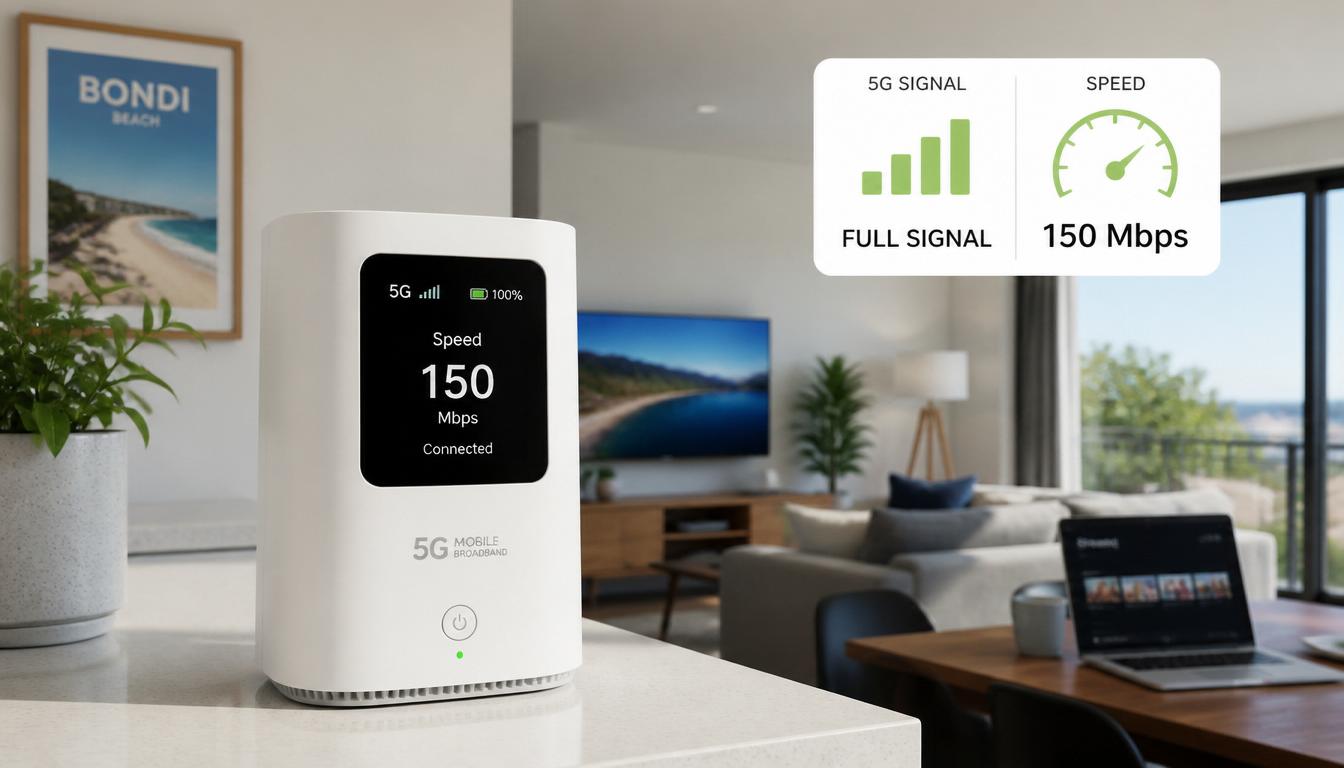
With 5G networks expanding fast, more households are asking whether they even need a fixed-line connection anymore. If you’re tossing up whether to go with 5G vs NBN, the decision paralysis is real. Finding a service that keeps your entire household online and ensures you can work from home lag-free comes down to what type of connection you have installed, how you use the internet, and what you value most in a plan.
We’ll help you compare the benefits of 5G home internet vs NBN, their speeds, availability, and costs, so you can spend less time on Australian internet comparison sites and make the right call for your household.
What is the NBN?
The National Broadband Network (NBN) is Australia’s fixed-line internet infrastructure, built to deliver fast, reliable broadband to homes and businesses across the country. Depending on the infrastructure available, your home can be connected with a mix of technologies, including Fibre to the Premises (FTTP), Fibre to the Node (FTTN), Hybrid Fibre-Coaxial (HFC) and Fixed Wireless.
NBN. Co., a government organisation, provides the infrastructure needed for retail service providers, such as MATE, to offer services to customers. The NBN rollout is complete across much of Australia, meaning the majority of homes can connect today. Some properties, particularly in newer developments or those on FTTP or HFC connections, may even be eligible for a fibre upgrade, unlocking typical busy-period speeds of up to 1,831 Mbps.
For people with demanding needs to stay online, how close you are to experiencing the best home internet in Australia depends on your connection type. Those with a higher mix of fibre-optic cabling, such as FTTTP and FTTC, can deliver faster download and upload speeds.
What is 5G home internet in Australia
5G home broadband uses the same wireless technology that powers 5G mobile phones to deliver internet to your home. A small plug-and-play router connects your service to nearby 5G towers without additional cables or installation. That makes it an attractive option for renters or households in areas with limited NBN infrastructure.
Is 5G Better Than NBN?
It depends on your situation. For most Australian households, especially heavy streamers and gamers, WFH, and large households, the NBN remains the more consistent and reliable choice.
But 5G has genuine advantages in certain contexts, particularly for renters and in areas with limited NBN infrastructure. Here’s a side-by-side look at 5G broadband vs NBN across several key metrics:
| Feature | NBN | 5G Home Internet |
|---|---|---|
| Technology | Fixed-line (fibre, copper, HFC) | Mobile wireless |
| Typical speeds | 25 Mbps – 1,831 Mbps (depending on your plan) |
50 Mbps – 500+ Mbps (depending on your plan) |
| Latency | 10–30 ms | 20–60 ms (variable) |
| Reliability | Very high | Moderate (network-dependent) |
| Data limits | Unlimited with a MATE plan | Varies by provider |
| Availability | Wherever NBN has been installed | Where 5G towers exist, and your provider’s ability to accept more users in a certain area |
| Contracts | No fixed, lock-in contracts with MATE | Varies by provider |
| Avg. monthly cost | $–$$$ | $$–$$$ |
| Best for | Families, WFH, gaming, streaming | Renters, rural areas, backup |
NBN vs. 5G Broadband: Let’s Break it Down:
1. It’s All Down to the Realised Home Internet Speeds
On paper, both technologies can deliver impressive speeds. NBN plans in Australia range from entry-level 25 Mbps connections perfect for light internet users, right through to ultrafast 2,000 Mbps plans for serious bandwidth on eligible connections. Don’t need to go that extreme? A medium 100/40Mbps plan is plenty for many households.
The NBN tends to win on speed consistency. Because it uses a physical connection, you get predictable performance whether it’s midday or peak evening hours. With 5G, speeds can drop during busy periods as more users connect to the same tower.
5G technology is fantastic for staying connected with your mobile phone while you’re on the go; however, its real-world performance is very different. While its theoretical speeds of up to 20 Gbps sound promising, they’re more often than not unlikely. Its capabilities depend on how close you are to the 5G tower, how many users are sharing the network, whether your area has dense coverage, and other environmental factors.
2. Reliability and Consistency
For many households, reliability is the biggest factor in Aussies’ final decision between NBN vs 5G broadband. NBN’s fixed infrastructure means your connection is generally stable and unaffected by conditions that affect wireless signals.
5G connections can be affected by a range of factors, including distance from towers, physical obstructions (walls, trees, buildings), network congestion and weather. While modern 5G technology has improved significantly, these variables mean performance is harder to guarantee.
More unnerving, you may not be unable to sign up for a 5G internet service, even if your neighbour has the exact package you want. Many 5G providers limit the number of customers they serve in any given area to balance traffic and constraints on the network constraints.
3. Which is Better for Gaming, 5G or NBN?
For gamers, latency (ping) matters as much as download speed. High latency causes lag, which is the enemy of competitive online gaming. NBN typically delivers lower latency on a well-configured connection. For live games that demand bandwidth and low latency, you should consider the following MATE NBN plans:
- You Beauty 100/40
- No Worries 500/50
- Fair Dinkum 750/50
- Flamin’ Fast 1000/100
5G latency has improved considerably with newer networks, and can reach as low as 20–30 ms under ideal conditions. However, wireless interference and network load can push this higher, making 5G home broadband too time and environment-dependent to be a reliable NBN alternative for high-action gaming.
<h4> 4. Managing Heavy Streaming and Multiple Users
Households with multiple users streaming, video calling and browsing simultaneously need bandwidth that doesn’t buckle under pressure. This is where NBN’s fixed, dedicated connection really shines.
A 4K stream uses around 25 Mbps. On days when two people are streaming 4K video, another person is on a video call, and a fourth person is gaming, your household’s requirements can easily be pushed to 80–100 Mbps or more. MATE’s No Worries NBN 500/520 or the No Worries 100/20 are built for exactly this.
With 5G home internet, the challenge is congestion. During peak hours, shared wireless spectrum can see speeds drop, impacting streaming quality when the whole family is online at once. For the best home internet Australia has available for busy households, NBN is the safer, more scalable choice.
5. Is 5G Good Enough for Working From Home?
For light work, emails, document editing and occasional video calls, 5G can absolutely get the job done. But for demanding remote work scenarios involving frequent video conferencing, large file transfers or VPN connections, NBN’s consistency is the better bet.
Working from home requires not just download speed but also reliable upload speed. NBN plans with higher upload tiers, like MATE’s You Beaut 100/40, are purpose-built for professionals who can’t afford dropped calls or sluggish uploads.
When 5G Might be the Better Option
Despite NBN’s strengths, there are genuine situations where 5G home internet makes more sense. Here’s when to consider it:
- You’re renting and don’t want to wait for an NBN installation or deal with the landlord.
- You have an FTTN connection type and live far from the node, resulting in poor speeds due to old copper wiring.
- You live in a major city with dense 5G coverage and a tower nearby.
- You need a temporary internet solution while moving or setting up a new home.
- You use the internet lightly and don’t need the consistency of a fixed connection.
In these cases, 5G broadband vs NBN is a closer contest, and 5G may well be the more convenient option.
When NBN is the Better Choice
For the majority of Australian households, NBN remains the best home internet Australia can offer. Consider NBN if:
- You have a family with multiple users streaming, gaming or working from home simultaneously.
- You need consistent upload speeds for video calls, cloud backups or content creation.
- You’re a gamer who needs low, stable latency.
- You live in an area with limited 5G tower coverage.
- You value predictable performance month after month without congestion surprises
If you’re currently on a slow NBN plan and wondering whether to switch, it might be worth changing NBN providers before writing off NBN entirely. A better provider or higher speed plan, often makes more of a difference than switching technologies.
5G Internet vs NBN: How Much do Different Internet Plans Cost?
Cost is always a factor in any internet comparison in Australia. Here is how the two stack up in 2026:
NBN plans from MATE are competitively priced to match every budget and come with:
- Unlimited data
- No lock-in contracts
- No setup fees when using your own modem
- No plan change fees
- Australia-based support
MATE’s flexibility makes it easy to find the best internet deals for new customers. You could save even more money by bundling your NBN home internet with a mobile service.
On the other hand, 5G home internet plans in Australia can be more expensive for very basic packages, which often include data limits and capped speeds. Your service may also be deprioritised during peak periods to balance network congestion, lessening the value you actually receive.
On a straight cost-per-value basis, ordering the NBN with MATE offers higher value, benefits, and cost savings than other NBN alternatives, enhancing your experience for as long as you browse, stream, and game with MATE.
5G vs NBN: What’s Right For You?
If you’re actively searching for an NBN alternative, 5G home internet is currently the most viable option. However, it comes with trade-offs. The reality is that for most Aussies, the NBN remains the most reliable and value-packed option for home internet.
If you’re ready to get onto a great-value NBN plan with no contracts, no setup fees and all-Aussie support, add NBN to your account with MATE today, or explore the full range of MATE NBN plans to find the right fit.
FAQs
Is 5G faster than NBN?
It can be, provided that your area has wide coverage, there is little network congestion, and there are no obstacles, such as trees and thick walls, blocking the signal. In most cases, the NBN can provide consistently fast speeds during peak periods.
Is NBN more reliable than 5G?
Generally, yes. NBN uses a fixed-line connection, which is less affected by interference, congestion, and distance than 5G wireless signals.
Can I replace NBN with 5G?
Yes you can, however be aware of the downsides of 5G consistency and check your usage. Many 5G home internet plans do not have unlimited data. If you download alot, nbn is still the better choice.
Is 5G good enough for working from home?
For basic remote work involving emails, simple written documents and spreadsheets, 5G can be sufficient. But if you’re regularly on video calls, working with large files and cloud networks, or relying on a VPN, the consistent upload speeds and low latency of NBN will serve you better.
Which is better for gaming, 5G or NBN?
NBN is generally the better choice for gaming. It offers lower and more consistent latency, which is critical for competitive online play. Fixed wireless connections are more susceptible to fluctuations that cause lag.
Why do some people choose 5G over NBN?
The main reasons are convenience and flexibility. 5G home internet requires no installation, no technician visit, and no long sign-up process, making it appealing for renters, people moving house or those on short-term arrangements. Some users in areas with poor FTTN NBN also find 5G broadband outperforms their fixed-line connection.